
GR-20/2026: The End of Artificial MSMEs?
By: Calvin Valenzuela, pegawai Direktorat Jenderal Pajak
For years, Indonesia's micro, small, and medium enterprises (MSME) Final Income Tax regime has been one of the most accessible tax facilities available to small businesses. Through a final tax rate of only 0.5% and a relatively simple administrative mechanism, the policy has helped millions of micro and small entrepreneurs participate in the tax system without facing the complexity of ordinary income taxation.
The policy has delivered substantial benefits with no doubt. However, an important question eventually emerged: Who actually receives the benefit?
At first glance, the answer appears straightforward. The beneficiaries are businesses with annual turnover below Rp4.8 billion. Yet economic reality is often more complicated than legal form.
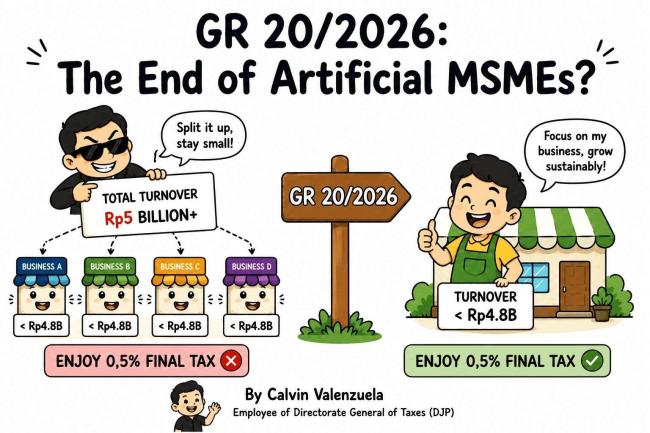
In many countries, tax authorities face a phenomenon known as bunching effect or firm splitting. In simple terms, a business that has economically grown beyond the intended threshold artificially maintains its eligibility for a tax incentive by dividing its activities into multiple entities, multiple owners, or multiple legal structures. Although each entity appears small on paper, the economic capacity behind them may tell a very different story.
Imagine a business owner generating Rp5 billion of annual turnover, instead of operating through one entity, the business is divided into several smaller entities owned by family members or related parties. As a result, each entity remains below the threshold and continues enjoying a tax facility originally designed for genuinely small businesses.
This situation creates a fundamental question: should tax incentives be determined by legal structure alone, or should they reflect actual economic capacity?
Government Regulation (GR) Number 20 of 2026 appears to answer this question by returning the MSME tax facility to its original purpose. The regulation maintains the 0.5% final income tax rate and retains the Rp4.8 billion turnover threshold. What changes is not the incentive itself, but the way the government identifies who should receive it.
The policy emphasizes more accurate targeting, fairness, legal certainty, and sustainability. New recipients are primarily focused on individual taxpayers, single-shareholder limited liability companies (Perseroan Perorangan), and cooperatives (Koperasi), while several business entities with more established organizational structures are directed toward the ordinary tax regime.
Furthermore, turnover aggregation rules have been strengthened to ensure that the Rp4.8 billion threshold reflects actual economic capacity rather than fragmented legal arrangements. Interestingly, individual tax payers generating turnover below Rp500 million also still enjoy facility: no need to pay income tax!
Some may perceive this adjustment as a tightening measure. However, such a perspective may overlook a broader issue: the preservation of a level playing field among MSMEs themselves.
Consider two businesses operating in the same market. The first is a genuine small enterprise with annual turnover of Rp3 billion. The second is a business group generating Rp8 billion in turnover but spread across several entities, allowing each entity to remain below the threshold. Both may end up enjoying the same 0.5% tax facility despite having significantly different economic capacities.
Under such circumstances, competition becomes uneven. Businesses that have effectively graduated into medium-sized enterprises continue receiving support intended for smaller players. Meanwhile, genuine MSMEs compete against larger competitors that benefit from the same preferential treatment.
From this perspective, GR-20/2026 is not merely a tax regulation, but a policy aimed at protecting the integrity of the incentive itself.
This approach is not unique to Indonesia. Internationally, tax authorities have increasingly shifted their focus from legal form to economic substance. Whether in transfer pricing, beneficial ownership, anti-avoidance provisions, or global minimum taxation, modern tax policy tends to evaluate the actual economic reality behind a transaction rather than relying solely on formal structures.
The same philosophy appears to be reflected in GR-20/2026. The regulation recognizes that a business should not remain classified as "small" simply because it has successfully fragmented its legal structure. Instead, businesses with more mature organizational capacity and larger economic scale are encouraged to participate in the ordinary tax regime, where taxable income is calculated based on actual profits and deductible expenses.
Ultimately, the most significant feature of GR-20/2026 is not the preservation of the 0.5% rate, although that remains important. Rather, it is the attempt to ensure that the facility reaches those who genuinely need administrative simplification and tax support.
After all, tax incentives are not merely about lowering taxes. They are also about determining who deserves the support. If the purpose of the MSME regime is to help small businesses grow, then perhaps the real challenge is ensuring that "small business" continues to mean what it was originally intended to mean. If a business has genuinely graduated to the next level, shouldn't the incentive be reserved for those who are still trying to get there?
*)This article represents the personal opinion of the author and does not reflect the official stance of the institution where the author works.
The content on this page may be copied and reused for non-commercial purposes. However, we kindly ask users to credit the source by linking back to the original page. Hopefully this helps.
- 247 views